You open an app store hoping to make running less daunting. A few minutes later, you are comparing training zones, achievement badges and subscription screens. You still have not found out what the first outing would ask you to do.
If you dislike running but want to give it another try, begin with a narrower question: which part would you like help with? An app can provide a plan or a prompt. It cannot decide whether this is an activity you want in your life.
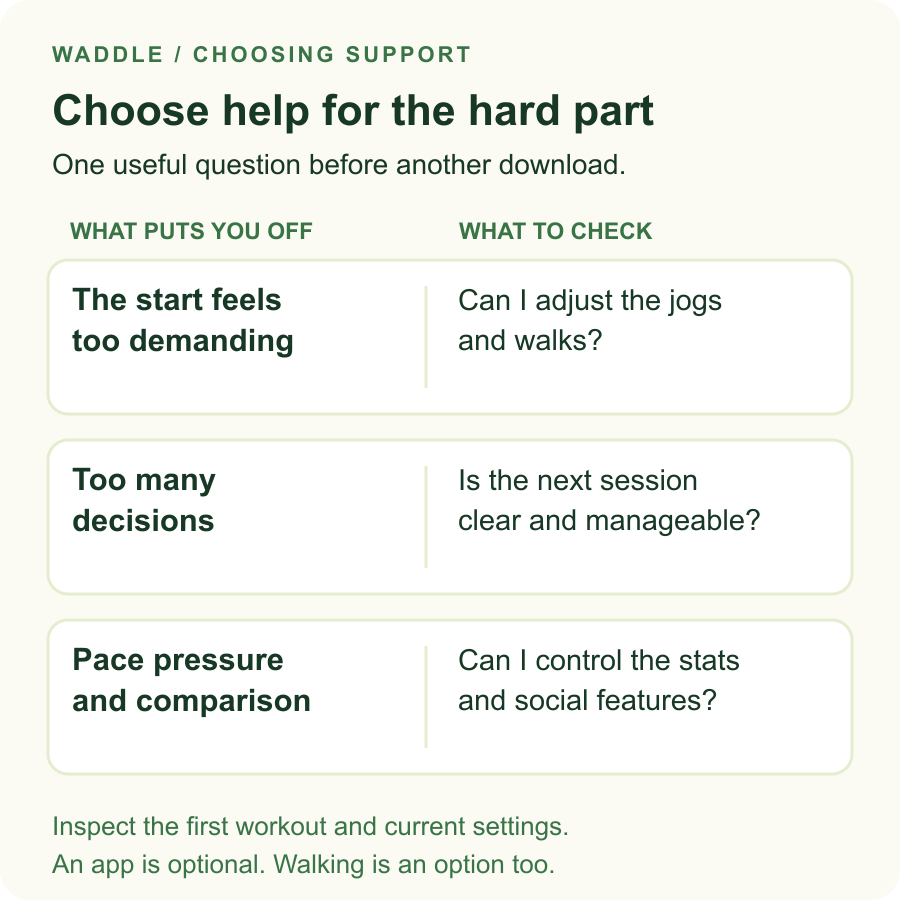
Name the part you dread
“I hate running” might mean that the first intervals feel too demanding, that deciding what to do is exhausting, or that every outing seems to turn into a pace comparison. It can also mean that running simply is not enjoyable for you. Those are different starting points.
Write one useful sentence before shopping: “I want someone to tell me when to walk,” or “I want a plan without a race deadline.” If you mostly want company, a local group that genuinely welcomes walk breaks may be more relevant than another screen. Ask what its outings involve before joining.
Inspect the first session, not the graduation promise
Look for an example of the actual starting workout. How long are its running portions? Are walks part of the plan? Can you repeat a stage, choose an easier option or stop without having to pretend you completed something else? Check the product's current instructions rather than assuming that “beginner” means the same thing everywhere.
Run-walk plans are an established beginner option: the NHS Couch to 5K programme starts with running and walking and allows nine weeks or longer to complete it. That does not mean its starting point, or any other app's first session, will suit everybody. A longer completion window is not a guarantee of an appropriate workout.
If a plan already feels too hard, choosing a different logo may not solve the difficulty. Look at the effort, interval length and recovery you are being asked to manage.
Use our Couch to 5K difficulty guide to work out what needs changing.
Choose prompts you would actually want to hear
Some people want a voice to mark each change. Others would rather hear a simple sound, see a clear timer or leave room for their own music. An enthusiastic coach is only helpful if you find that style encouraging.
Check what the app says about its cues and controls. If a preview or trial is available, try the controls while stationary: can you understand the next instruction, pause the session and finish it? If you use headphones, choose a setup that lets you stay aware of your surroundings. You should not need to keep studying the display while moving.
Treat compatibility questions as practical checks. If you need a particular watch, screen reader, audio setup or phone-free experience, confirm that exact support in the current documentation. A screenshot of a watch or a general accessibility claim is not enough to settle your own requirements.
Decide what information helps you return
A pace chart can be interesting. It can also be the first thing you use to tell yourself that the outing was not good enough. Think about whether you want detailed numbers immediately, a simple record of what you did, or very little tracking at all.
Before choosing an app, inspect how it handles social feeds, rankings, reminders and missed sessions. Can you control the parts you do not want? Does the language make sense for a person who might walk the whole outing? These are preferences to check, not proof that one design works for everyone.
You can keep your own success measure small: you understood the session, could change course when needed, and would consider doing another outing. You do not have to share a route or a result for it to count as time you chose to spend moving.
Where Waddle fits
We make Waddle, so this is our own product's guide—not an independent ranking. Waddle is designed around beginner run-walk plans, with an animated goose accompanying the session. Its current product pages describe plans based on your goal, jogging comfort and weekly rhythm, plus options to shorten jogs and lengthen walks.
It also offers on-screen, sound and optional spoken interval cues, without a required pace target. Those choices may suit you if you want help with what to do next and permission to use walk breaks. The goose is there as a companion; it is not a substitute for a qualified coach or health professional.
If detailed race analysis or a competitive community is your main reason for choosing an app, use those needs to guide your search. If you want a gentler structure to try, look at Waddle's actual screens and decide whether its approach appeals to you.
See Waddle's plan and interval screens.
Make the first decision reversible
Before paying for any app, check the price, what is included, whether a trial renews, how cancellation works, and which permissions are required for the features you want. Read the current store listing and purchase screen; a free download does not necessarily mean the whole app is free.
Then choose a small test. Preview one session and its controls. If it suits your circumstances, try a manageable outing and note what the app made easier or more awkward. You do not need a collection of simultaneous plans to make the decision properly.
You can also start with a written guide instead of an app. That may be enough if you prefer fewer prompts and already know how you want to structure the outing.
Read the free beginner run-walk guide, including its starting assumptions and adjustment notes.
You are allowed to choose something else
No download comes with an obligation to become a runner. You might find a version you enjoy, decide it is useful without loving it, or prefer walking. You can also revisit the question later. There is no need to turn a preference into a personal failure.
Walking can be the whole plan; here is a practical way to approach it.
If the problem is pain, concerning symptoms or a health question, app selection is not the next step. Seek appropriate medical advice. The NHS advises talking with a GP before starting Couch to 5K if you are worried about your health.
Written by Waddle's publisher; sources and product descriptions checked October 29, 2026. Community discussions about not enjoying running helped frame the questions. We have not copied personal stories, treated replies as health evidence or claimed that an app will change how you feel.
Common questions
Can an app make me enjoy running?
It may make planning or following intervals more convenient, but enjoyment is not guaranteed. Choose it for a specific job you want help with, then judge whether it suits you.
Should a beginner app include walking?
If you want run-walk guidance, check that walking is part of the actual session and that its starting demands fit you. The word beginner alone does not establish that.
Do I need to use an app at all?
No. A suitable written plan or a walking outing may be enough. An app is an optional source of structure, cues or tracking.
Sources and further reading
We use plain language and conservative beginner guidance. These sources provide additional public-health and clinical context.
This guide is general educational information, not medical advice. A qualified professional can help you adapt activity to your health, symptoms, or injury history.