
The app announces the next running interval. You are still trying to recover from the last one. Finishing the session suddenly feels a long way away, never mind finishing the programme.
That is useful information about this outing. It is not a verdict on every run you might do. Before adding determination, work out what you are asking yourself to manage—and which part you can change.
Make “too hard” more specific
Think about where the difficulty began. Were the first few seconds already a rush? Did the later repetitions become much harder? Did the next scheduled week ask for a jump you did not feel ready to make? Or were you trying to fit a session into a day when you were already worn out?
Write one ordinary sentence about it: “I could manage the early intervals, but I could not settle during the later walking parts.” That gives you more to work with than “I failed week two.” Keep pace, interval length and your recovery between outings separate when you review the session.
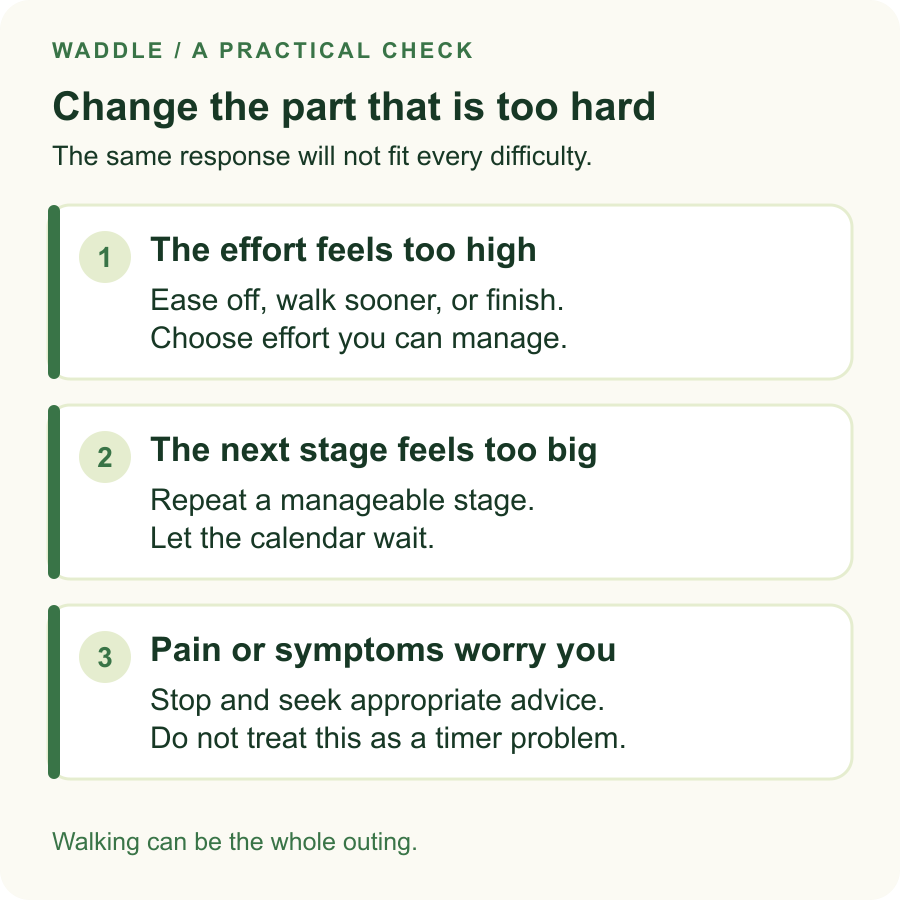
Check the effort before chasing the timer
A prompt to run does not mean a prompt to run fast. Try an easier effort instead of trying to match another runner, a treadmill setting you used years ago, or the pace you think ought to count.
The CDC describes the talk test as a rough way to judge intensity: moderate activity allows conversation, while vigorous activity makes more than a few words difficult without a breath. This describes effort; it is not a medical clearance test or a requirement to keep running.
For a gentle outing, use conversation as a cue to ease off. If slowing the jog still does not feel manageable, walk. You can also shorten the outing. There is no pace number in this article because the same speed can ask very different amounts of different people.
Read more about choosing a beginner running pace.
Let the walk break start before you are desperate for it
You do not have to wait for the audio instruction if you need to walk sooner. If the walking period ends and you do not feel ready to jog, keep walking or finish. The recording cannot see the hill, the heat, or how you feel.
For example, imagine that an interval is manageable at first but the final part turns into a struggle. On a later outing, you could try a shorter jogging portion with more walking instead of aiming for the same finish at any cost. That is an option to discuss with a qualified professional if you need individual guidance; it is not a replacement schedule everyone should follow.
If the first stage still feels too demanding, choose comfortable walking for now. You can return to running when you want to explore it again. Walking does not have to become a waiting room for a more acceptable activity.
Walking can be the whole plan. Here is why it belongs here.
Repeating a week is an option, not an automatic instruction
The NHS says its Couch to 5K programme can take nine weeks or longer. Chainbridge Medical Partnership's NHS guidance also explicitly allows repeating a week when you do not feel ready for the next one. You are allowed more time.
Repeating is most useful when you know what you want from another attempt. Perhaps you want to try the current stage at an easier effort, or repeat a session that felt manageable before adding longer running intervals. You can keep the same stage while changing the condition that made it difficult.
Repeating an outing that leaves you struggling every time, with nothing changed, may simply give you another difficult outing. Consider a smaller starting point or seek individual guidance instead of treating the week number as a test you must pass.
There is no universal number of repeats that proves you are ready. Look at whether the current outing feels manageable and how you recover, rather than whether a particular date has arrived. You can also decide you prefer a different goal.
Keep room between running days
The NHS programme schedules three runs a week with rest days between them. If you miss a session, avoid turning the following days into a catch-up challenge. Move the schedule so there is still room between runs.
A short note can help you see the circumstances without turning every outing into a spreadsheet: where you went, which part felt difficult, and how you felt afterward. If the hard attempt happened on a steeper route or a rushed day, that context belongs in the decision about what to do next.
Choose one change for the next outing
Keep the plan small enough to remember when you leave home. Here are examples to adapt, rather than instructions to progress through:
- “I will use the familiar flat route and make the jogging easier. I can walk whenever I need to.”
- “I will repeat the last manageable stage instead of moving to the longer intervals today.”
- “I will take a comfortable walk and leave the running decision for another day.”
Afterward, ask whether the change helped with the specific difficulty you identified. A shorter outing with a clear stopping point can teach you something useful. You do not need to compensate for it by adding extra work next time.
Use a plan that leaves room for your starting point
If you want a written schedule with shorter initial running intervals, our existing beginner run-walk guide is linked below. Read its starting assumptions and adjustment notes before using it. It is general guidance, and it may still need adapting to you.
Explore Waddle's gentle beginner run-walk plan.
Waddle offers guided beginner run-walk plans with a goose companion. That may suit you if you would like prompts and a friendly structure. Changing apps does not guarantee that an outing will feel easier; the plan still needs to fit your present ability and circumstances.
Sources and product wording checked October 28, 2026. The examples are editorial suggestions, not personal coaching or invented customer results. Community questions helped identify the uncertainty about repeating weeks; they are not evidence that one approach works for everyone.
Common questions
Is Couch to 5K week one supposed to feel easy?
People begin with different abilities and experience. A beginner label does not guarantee that every interval will suit you immediately. You can use more walking, a shorter outing or individual guidance instead of forcing the written session.
Do I have to finish in nine calendar weeks?
No. The NHS explicitly says its programme can take nine weeks or longer. The next stage can wait while you find an outing you can manage.
Do I have to run 5K in 30 minutes?
No. Thirty minutes of continuous running and covering five kilometres are different goals. The distance you cover depends on your pace. There is no need to add a speed target while you are learning what feels manageable.
Sources and further reading
We use plain language and conservative beginner guidance. These sources provide additional public-health and clinical context.
This guide is general educational information, not medical advice. A qualified professional can help you adapt activity to your health, symptoms, or injury history.