What part of being outside feels difficult?
Your shoes are on, but you are still standing by the door. Maybe you picture a neighbour seeing you walk after a short jog. Maybe you worry about being the last person in a group. Or perhaps the route itself does not feel comfortable. Each concern deserves a different response.
Try finishing this sentence: “The part I am worried about is…” Be as specific as you can. You can plan for passing a familiar face or asking a group to slow down. It is much harder to plan around a vague feeling that you need to become a different person first.
There is no need to promise yourself that nobody will notice you. Someone may. You can still use a public path, move at your own effort, and take up the space you need. Another person's glance does not create an obligation to keep running.
Choose an outing with a clear ending
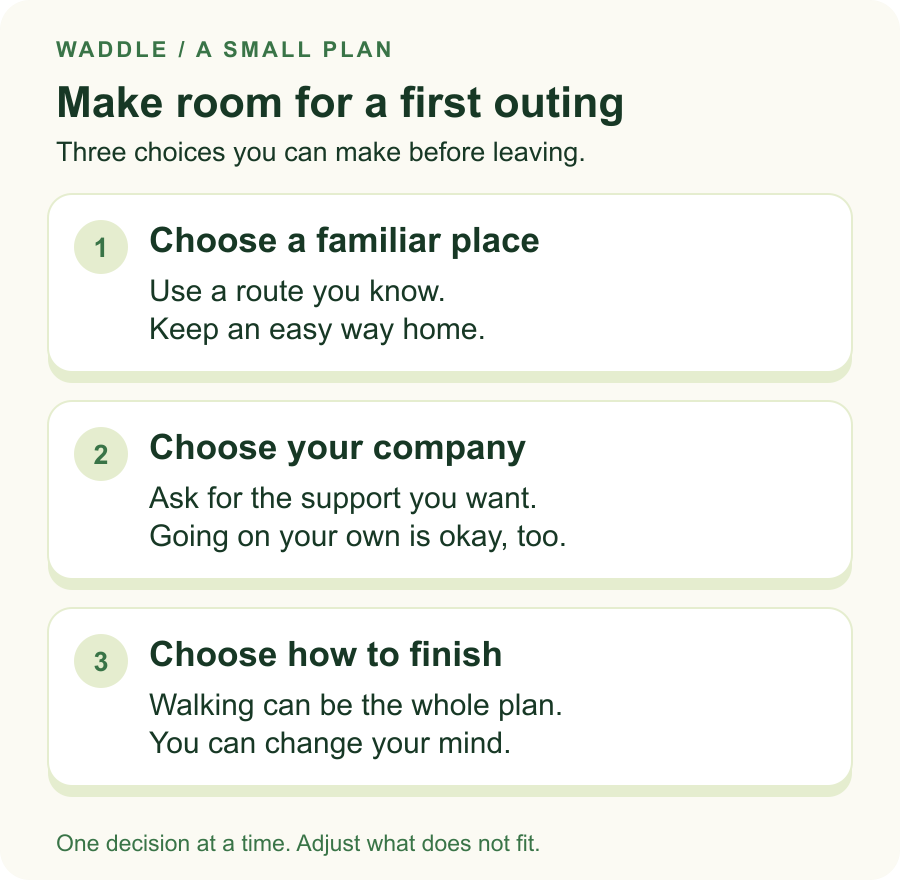
Instead of deciding to “become an outdoor runner” today, choose one manageable visit to a place you already know. That could be a walk around a local park with an optional gentle jog along one part. If walking is what feels manageable, leave the jogging for another time.
Decide how you will get home and where you can shorten the outing. A route you can leave easily gives you choices if the weather changes, your effort feels too hard, or you simply want to finish. There is no distance you have to complete to make the visit count.
Choose a place and time that feel safe to you. Being self-conscious is not a reason to seek out an isolated or poorly lit route. Check access rules for tracks or sports grounds, and account for crossings, visibility, weather and your own accessibility needs.
Ask for the kind of company you actually want
A supportive friend can help, but a well-meant surprise workout might not. Be clear before you meet: “I'd like company, but I want to choose the effort and walk whenever I need to. Please don't turn this into a challenge.” You can ask them to chat about something ordinary instead of commenting on your running.
If you prefer going alone, that is also a reasonable choice. You can choose how much to share afterward. There is no requirement to post the route, pace, photograph or distance online.
Before joining a group, ask what “beginner friendly” means
The label can cover very different sessions. One group might welcome people walking most of the route; another might expect everyone to run continuously at its slowest advertised pace. Finding that out beforehand is useful planning.
- Are planned walk breaks part of this session?
- Is there a pace or distance I need to manage before joining?
- What happens if I need to stop or leave early?
- Does someone stay with the last participant, and how is that arranged?
- Can I come for a walk first or talk to the leader before the start?
Their answers can help you decide whether this particular outing suits you. If it does not, you can choose another group, ask one person to join you, or go on your own. Needing a different session says something about the match between the session and your needs, not whether you belong outside.
Have a response ready for the awkward moment
Imagine you are walking when somebody approaches. If you feel tempted to jog just until they pass, return to the plan you made: this is a walking part. You can offer a nod if you want, or keep your attention on where you are going. You do not need to explain the interval.
If you meet someone you know, a short answer is enough: “I'm trying a little running and walking.” You can leave it there. If somebody makes an unkind comment, you do not have to defend your pace or appearance. Choose the response that protects your comfort and safety, including leaving the situation or seeking support.
Avoid using a stranger as your finish line. When you want to walk, walk; when you need to stop, stop. New or concerning physical symptoms deserve attention rather than being dismissed as nerves. A professional can help if you are unsure what activity is appropriate for your health.
Review what made the outing easier to begin
Afterward, jot down one detail you would keep and one you would change. Perhaps meeting your friend at the entrance helped, while choosing a busy crossing added stress. Those are useful observations even if you walked the entire time.
If you want another attempt, repeat the manageable part rather than adding several new challenges at once. The NHS suggests small achievable targets and gradually spending time in situations that cause anxiety. That general guidance is linked below; this article is not a treatment plan or a promise that repeated outings will remove anxiety.
If fear is intense, persistent, or affecting other parts of your life, consider speaking with a qualified health professional. You can get support without first proving that you have tried hard enough on your own.
Let the running plan serve your choice
Once you want a structure for the running itself, use the beginner run-walk guide linked below. The NHS Couch to 5K programme also begins with a mix of walking and running and allows longer than its nominal nine weeks. A schedule is something to adapt to your current starting point.
Waddle offers guided beginner run-walk plans with a goose companion. It may help if deciding when to change between walking and running is one more thing you would like taken care of. It does not assess or treat anxiety. If an ordinary walk is what you want today, you can take it without an app or a new goal.
Sources and product wording checked October 27, 2026. The outing examples and conversation scripts are suggestions from Waddle's publisher, not personal testimonials. Reader discussions about embarrassment informed the topic; they do not establish how common it is or which approach will work for you.
Common questions
Do I need to stop caring what people think before I run?
No. You can try an outing while still feeling a little self-conscious, and keep it manageable. If the feeling is overwhelming, it is reasonable to seek support rather than forcing yourself through it.
Is a treadmill an acceptable place to start?
Yes. You can choose an indoor setting if it fits your comfort, access and preferences. Outdoor running is an option, not a test you have to pass.
What if I walk the whole way?
Then you went for a walk. You can still learn about the route, the time of day and whether you would like to return. Running does not have to be added later unless you want it.
Sources and further reading
We use plain language and conservative beginner guidance. These sources provide additional public-health and clinical context.
This guide is general educational information, not medical advice. A qualified professional can help you adapt activity to your health, symptoms, or injury history.