
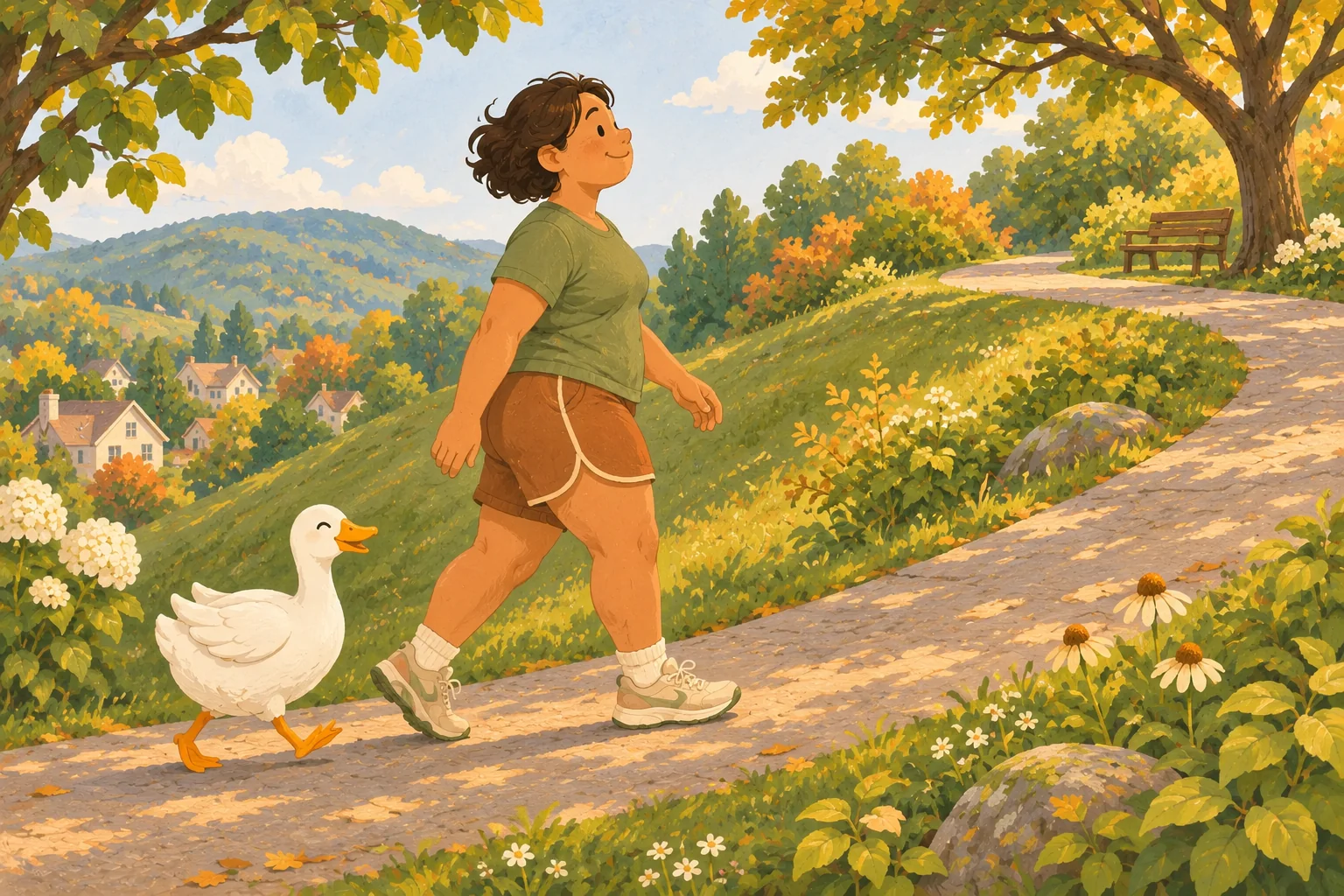
The beginner advice says to find a flat route. You look out of the window. Your neighborhood appears to have missed that meeting. If every useful way out includes a slope, you can adapt the outing around the ground you actually have.
The first decision is whether the route is manageable at all. After that, you can decide where to walk, where an easy jog might fit, and when to head home. You do not have to turn an ordinary local outing into a hill workout.
Let the hill change your pace
A pace that feels comfortable on a level path can feel much harder on an incline. Trying to hold the same number everywhere may turn a gentle outing into something you did not intend. Leave the pace target out of the first few visits and notice your effort instead.
The CDC describes the talk test as a rough guide to intensity: during moderate activity you can usually talk but not sing; during vigorous activity you can only manage a few words before pausing for breath. It is not a medical clearance or a requirement to reach a particular intensity. For a gentle beginner outing, needing to gasp through a sentence is a useful reason to ease off, walk or stop.
CDC: understanding activity intensity
Walking uphill can still feel demanding. Changing from running to walking does not guarantee that the effort becomes easy. Slow further, take a break or choose a less demanding route if that is what you need. Stop if something does not feel right; persistent pain or concerning symptoms deserve medical advice, not another attempt at the hill.
Find a manageable effort without chasing a pace
Walk the climb before you are forced to
You can choose to walk as the path rises, even if your timer has just announced a running interval. The instruction describes a plan; it cannot judge the slope, the surface or how you feel. Continue walking for as long as you need. Jog again only if the conditions and your effort make that a reasonable choice.
For example, a beginner might walk from home to a nearby gentle stretch, try their planned run-walk intervals there, and walk the slope on the way back. Another might make the entire visit a walk while finding out which parts of the route feel comfortable. Neither example is a training prescription or a minimum to complete.
If the timer and the terrain keep disagreeing, make the next outing simpler rather than repeatedly trying to catch up. A shorter route, an easier version of your plan, or a different location can all be useful adjustments.
When a beginner running plan feels too hard
Look for a usable stretch, not a perfect flat town
You may have more options than either running every hill or driving somewhere far away. On a walk, look for a short section that you can use comfortably in both directions. A park path, an accessible track during public hours, or a quiet level stretch may work. Check access rules and local conditions; a line on a map does not tell you whether a path is open or suitable.
- Check the return journey. An easy downhill start can leave an uphill trip home when you are ready to finish.
- Consider crossings, traffic, visibility and the surface before the slope. A flatter road is not a better choice if it is unsuitable for pedestrians.
- Keep an easy way to shorten the outing. You can repeat a small section instead of committing to a long loop.
- Use your own access needs and available time. A route that requires an inconvenient journey may not be a practical everyday option.
Repeating a short section is allowed to be ordinary. You do not need a scenic new circuit each time. If the local terrain is not manageable, an accessible indoor option or walking elsewhere may fit better. You also do not have to buy a gym membership to prove that you are taking this seriously.
Choosing between a treadmill and outdoor running
Give the downhill its own decision
A descent is not an instruction to make up time. Choose a speed at which you feel in control and can respond to the path ahead. Walking down is a valid option too. If a steep or uneven section feels beyond what you can manage, use another route rather than treating it as a test.
REI’s hill-running guidance includes walking when needed and building familiarity with hills gradually. Its training sessions are aimed at a different question from simply finding a manageable first outing. You do not need hill repeats, a summit target or a promised performance benefit to use your neighborhood path.
REI: guidance on uphill and downhill running
Weather can change the same route considerably. If rain has affected visibility or footing, reassess the outing instead of assuming yesterday’s route will feel the same.
Making a beginner outing work around rain
Keep the rest of the plan modest
If hills are the new part, there is no need to also add more time or chase a faster pace. Keep room for rest between beginner runs. The NHS Couch to 5K plan recommends a rest day between runs and starting at your own pace. If you are worried about your health before beginning, ask a qualified health professional about an appropriate starting point.
NHS: beginning with run-walk sessions and rest days
Waddle offers guided run-walk intervals and adjustable effort if you would like a plan to follow. You still choose the route and decide when to walk or stop; a running prompt is not a reason to push through a difficult section.
How Waddle supports beginner running
Afterward, note one practical detail: the far slope was too much, the short level stretch worked, or the return journey needs a different plan. That gives you something to change next time without grading the entire outing by pace.
You are allowed to live somewhere hilly and begin gently. Walking the climb can be part of how you make that possible.
Sources and further reading
We use plain language and conservative beginner guidance. These sources provide additional public-health and clinical context.
This guide is general educational information, not medical advice. A qualified professional can help you adapt activity to your health, symptoms, or injury history.