
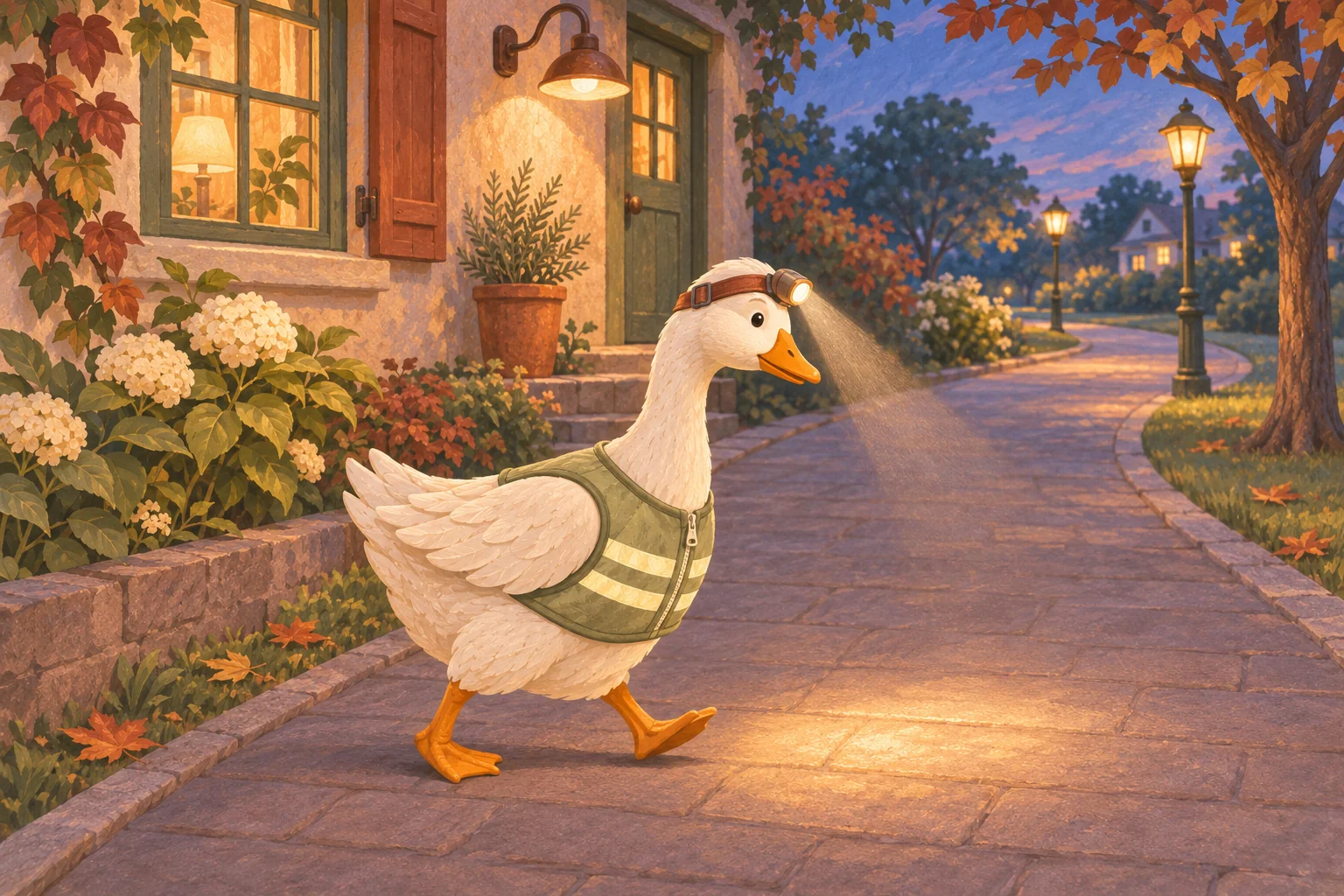
You find a gap before work or after dinner, and discover that your available running time now comes with darkness. It is a different planning problem from finding the right pace. A route that feels straightforward at lunchtime may be harder to judge when you cannot clearly see the pavement.
You do not have to make your first outings in the dark. If you are still getting used to running, starting in daylight or in a suitable indoor setting lets you learn the activity with fewer things to manage. If you are considering an outing after dark, make the decision around the route and conditions, rather than the fact that your calendar says “run.”
Choose the route before the workout
Start with somewhere you know in daylight. Look for usable pedestrian space, lighting and a surface you can see clearly. A short loop close to your starting point gives you a straightforward way to end the outing. Check whether a park, track or other facility is open and lit at the time you intend to use it; daylight opening hours do not tell you that.
The NHS advises runners in the dark to make sure they can see where they are going and can be seen by other road users, and suggests well-lit routes and reflective clothing. Familiarity helps with planning, but it does not make a broken light, roadworks or a new obstacle disappear.
NHS: getting started and running safely
Before leaving, ask three concrete questions: can I see the surface ahead, where would I turn back, and does the return route stay suitable too? If the answers depend on hoping an unlit section will be fine, choose a different route or time. Repeating a manageable loop is a perfectly reasonable plan.
For routes near traffic, use sidewalks when available. The US National Highway Traffic Safety Administration recommends crossing at crosswalks or intersections where possible, checking for vehicles in every direction, and following signs and signals. Do not assume a driver has seen you. Follow the rules where you are, and choose a route separated from traffic when you can.
Plan for seeing the ground and being seen
Those are related jobs, but they are not identical. A headlamp or suitable handheld running light can help illuminate the surface ahead. Reflective clothing and visibility lights help other people notice you. A bright-colored top alone is not a substitute for an after-dark visibility setup.
REI’s night-running guidance distinguishes a light for the path from reflective clothing and safety lights. Use that distinction when checking what you already have, rather than assuming one small light solves everything. No piece of equipment makes a poor route suitable or guarantees that a driver will respond.
- Check the charge or batteries and the manufacturer’s runtime guidance for the setting you will use. Allow for the way home, not just the outward section.
- Try the light while walking in a clear, familiar space. Check that you can see the ground you are about to use without constantly adjusting it.
- Check that a jacket, bag or other item has not covered your reflective details or visibility light. Think about visibility from more than one direction.
- Aim a directional light at the path rather than other people’s eyes, and stop somewhere clear if you need to adjust it.
If your light slips, the beam is not useful or you cannot judge the surface, pause and change the arrangement. If you cannot fix the problem, end the outing or use another setting. You do not need to turn an equipment test into a full session.
Make the first outing easy to end
Try the setup close to your starting point before committing to a longer route. Walk while you check the light, the surface and how the area feels. If everything is suitable and you want to jog, keep to an effort you can manage while paying attention to your surroundings.
Walk through an uncertain section only if it is appropriate to continue at all. Walking is not a solution to ice, flooding, a closed path or a stretch you cannot see. Turn back or choose another option when the conditions call for it. A planned running interval does not take priority over a crossing or an obstacle.
You can finish after a small familiar loop. You can also decide that a walk is the whole outing. Neither choice needs a compensating hard session afterward.
Darkness and bad weather can arrive together. Check the forecast and the actual conditions outside; our rain guide covers wet surfaces and when to change plans. Do not treat a weather decision as a test of commitment.
Planning beginner outings in the rain
Keep your attention and a way to get home
The Road Runners Club of America recommends carrying a phone and identification, letting someone know you are out, planning familiar routes with options to change course, and maintaining awareness when using headphones. Tell a trusted person your intended route and expected return if that arrangement works for you.
Keep audio low enough to remain aware of what is happening nearby, or leave it off. If you need to read a map or change a setting, stop somewhere clear. A phone is useful, but reception, battery life and help are not guaranteed; it should not be the reason you accept an otherwise unsuitable route.
If you would feel more comfortable with company, arrange an outing that actually stays together, including walking breaks. Agree on that before leaving. If a local group cannot accommodate your current pace or preferred route, it is reasonable to choose a different group or plan.
Running with a faster friend without chasing them
Keep a daylight or indoor option available
A lunch break, a daylight weekend outing, a suitable treadmill or an indoor walking route may fit better than a dark route near home. You do not have to choose one setting permanently. The option that worked last week may be less useful when the lighting, weather or your schedule changes.
Try a simple decision before getting dressed: “If the path is lit and clear and my equipment works, I’ll do the short loop. Otherwise I’ll use my indoor option or move this outing.” That is an example you can adapt, not a safety certification for a route.
Choosing between a treadmill and outdoor running
Waddle offers guided run-walk intervals and adjustable effort for beginner outings. Use the plan where the conditions suit you. The app cannot assess lighting, traffic or your surroundings, and finishing a session is never more important than changing course when you need to.
The useful outcome is a plan you are comfortable repeating. Sometimes that includes an evening loop with walking breaks. Sometimes it is a decision to go tomorrow in daylight. Both are decisions you are allowed to make.
Sources and further reading
We use plain language and conservative beginner guidance. These sources provide additional public-health and clinical context.
This guide is general educational information, not medical advice. A qualified professional can help you adapt activity to your health, symptoms, or injury history.